


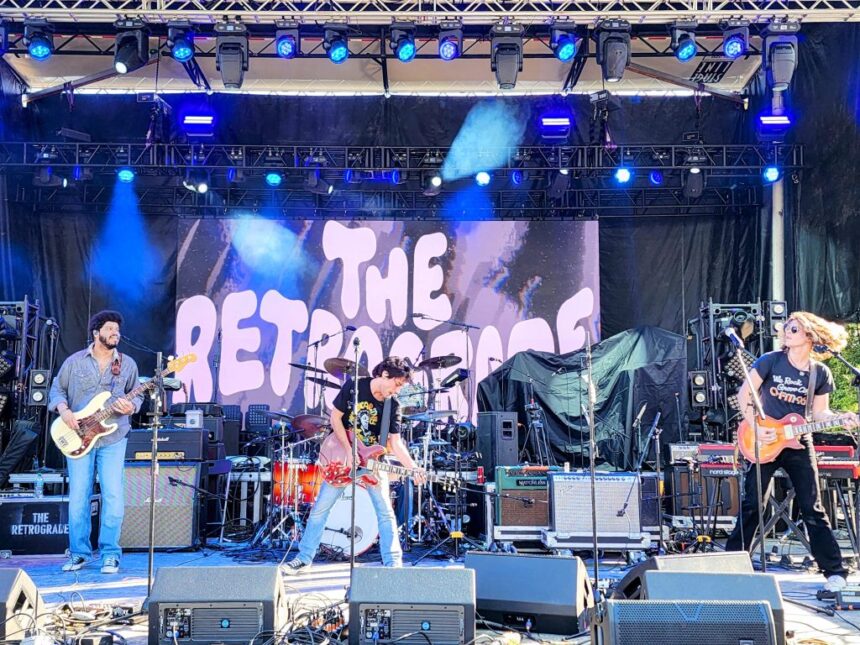
I had never heard of The Retrograde before I went to the SkyDog Music Festival in Muscle Shoals, Alabama. Their hard-driving music blasted across the grass field behind the Renaissance Shoals Resort and drew me right up to the stage.
I was close enough to see the sweat on lead singer Joe Fox’s face and the twinkle in his eye as he described the band’s big break. They had recorded “If 6 Was 4,” a sprawling six-minute rock song that sounds defiantly out of place in an era engineered around short attention spans. During the recording process, their producer let out an unscripted primal scream in reaction to what he was hearing. The band posted the raw moment online and, according to Fox’s story from the stage, woke up to millions of views.
That viral moment helped introduce a new generation to a band that sounds strangely familiar without feeling like a tribute act. The Retrograde pulls from the swagger, grit and melodic ambition of classic rock, but they are not interested in simply recreating 1974. They are trying to figure out what rock music can sound like now. Their music has found a growing audience online, while their live performances remain at the center of what they do.
Yet it wasn’t only the music that transported me backward. The opening lyric, “dreams feel awfully real ’till it’s dawn,” took me straight back to restless teenage nights when I would lie awake balancing angst and solitude with a quiet hope for connection. Then I noticed lead guitarist Cade Pickering’s shirt: “We Rock Grove City Q-FM 96”
Of all the shirts he could have worn onstage in Muscle Shoals, Alabama, he was wearing a relic from my childhood. I spoke with Pickering after the show, and for him, it was simply a cool vintage find and a great conversation piece. For me, QFM was something entirely different.
It was a constant companion on some of the loneliest nights of my adolescence. QFM did indeed rock Grove City, a ubiquitous suburb just beyond the outer belt of Columbus, Ohio, but it broadcast from my hometown of Upper Arlington. I spent countless nights reading books by flashlight beneath the covers with the Q playing quietly beside me, low enough that I hoped my parents would not hear. Four decades later, a guitarist young enough to be from another musical generation walked onto a stage in Alabama wearing a piece of my childhood.
That is one of the strange powers of live music. You can stream a song a thousand times and never know exactly when it will reach backward into your life, grab hold of something you thought you had forgotten and pull it into the present.
When the Algorithm Becomes the Record Label
Next up were Sons of Legion, one of my wife’s favorite new bands. Adam McInnis and Daddy Jack make music that feels as if someone dragged Southern soul, blues and old-school rock through the digital age without sanding off the rough edges. More interestingly, they have built much of their following outside the traditional machinery that once determined who got heard.
Their music has surpassed 55 million streams and appeared everywhere from ESPN and NBC to Netflix and advertising campaigns. They have done it while maintaining a fiercely independent approach to their music and identity, something that would have been almost unimaginable during the heyday of the record industry.
For much of modern music history, someone stood between the artist and the audience. A label decided which band received a contract. A producer decided which songs belonged on the record. Radio programmers decided what went into rotation. Executives worried about whether a song had a hook quickly enough, whether it fit the format and whether a four, six or nine-minute track could possibly survive commercially.
Today, TikTok, Instagram, YouTube and streaming platforms can collapse much of that structure into a phone. A band can make something strange, raw and completely outside the prevailing formula at midnight, post it themselves and potentially wake up to an audience. That is an extraordinary democratization of opportunity, but it is also where things get complicated.
The same technology that freed musicians from many of the old gatekeepers has created new ones. Instead of convincing a record executive that a song deserves a chance, musicians increasingly have to convince an algorithm. Songs are skipped in seconds, artists are encouraged to get to the hook faster, intros shrink and singles matter more than albums. Musicians must become filmmakers, editors, social-media managers, marketers and personalities alongside actually making music.
There has never been an easier time to release a song, yet there may never have been a harder time to make someone stop and truly listen to it.
What If “Free Bird” Had to Please an Algorithm?
Imagine someone telling Lynyrd Skynyrd that “Free Bird” needed to be three minutes long because listeners might swipe away.
The song grew organically over time. Its mournful first half expanded through live performances, its guitar finale stretched longer, and Billy Powell’s piano introduction became inseparable from the song. Skynyrd had already recorded early material in Muscle Shoals in 1971 and 1972 before recording the definitive version of “Free Bird” for their debut album in Georgia in 1973. That album version ran more than nine minutes.
Then something equally important happened. Lynyrd Skynyrd landed an opening slot on The Who’s 1973 American tour, and suddenly this relatively unknown Southern band was standing in front of huge rock audiences night after night. “Free Bird,” combined with that exposure, helped transform Skynyrd from a regional curiosity into a national force.
It is difficult to imagine a modern executive looking at a nine-minute debut-album track and seeing a radio hit, yet that is precisely the point. Some music needs room to breathe. Sometimes the introduction matters. Sometimes the silence matters. Sometimes the guitar solo needs another minute because cutting it makes the song technically tighter but emotionally smaller.
The great irony of technology is that it has given artists nearly unlimited freedom to create while simultaneously encouraging them to compress what they create into increasingly smaller packages. Muscle Shoals represents almost the opposite philosophy: come into the room, find the groove and see what happens.
Muscle Shoals Was Built on Musicians Listening to Each Other
It is difficult to talk about that philosophy without talking about race. The Muscle Shoals story unfolded in Alabama during the 1960s, when segregation and racial violence were very much part of everyday Southern life. Yet inside recording studios like FAME, Black singers and white session musicians were working together to create some of the most important soul music ever recorded.
That does not mean a recording studio somehow erased the racism outside its doors, nor should the history be simplified into a tidy story about music single-handedly solving segregation. What happened was subtler and, in some ways, more powerful.
Listeners across America heard Wilson Pickett, Aretha Franklin, Etta James and other Black artists backed by musicians many assumed were Black themselves. In reality, some of the musicians laying down those unmistakably soulful rhythms were white Alabamians whose musical vocabulary had been shaped by gospel, country, R&B, blues and the Black musicians around them.
The records became an audible contradiction to the racial boundaries society insisted were supposed to exist. Black and white musicians were listening to each other, responding to each other and creating something neither could have made quite the same way alone. At a moment when Alabama was synonymous with some of the fiercest resistance to integration, music coming out of the Shoals offered millions of listeners another version of the South.
It did not erase the divisions of the era, but it demonstrated, record after record, what collaboration sounded like. Radio carried that sound far beyond Alabama, and you did not have to know the race of the bass player to feel the groove. You simply had to listen.
The Place Where Musicians Were Allowed to Wander
The Muscle Shoals sound helped launch and redefine careers. Percy Sledge emerged from the region. Wilson Pickett cut landmark records at FAME. Aretha Franklin recorded the breakthrough “I Never Loved a Man (The Way I Love You)” there, helping ignite one of the greatest runs in American popular music. The Rolling Stones later recorded “Brown Sugar,” “Wild Horses” and “You Gotta Move” at Muscle Shoals Sound Studio.
Paul Simon came. Bob Seger came. Willie Nelson came. Rod Stewart came. They were not all looking for the same sound, and that was part of the magic.
The studios of Muscle Shoals became places where musicians could explore beyond the increasingly narrow expectations of the commercial music industry. The sound did not come from a machine setting labeled “Muscle Shoals.” It came from human beings responding to one another in a room.
A drummer might move slightly behind the beat and a bass player would answer him. A guitarist would find a lick nobody had planned, and the singer would hear it and change the phrasing. Maybe somebody in the control room would shout because something magical had just happened.
That last part sounds remarkably similar to The Retrograde’s story decades later. Technology changed, but the moment did not.
AI Can Recreate a Voice. It Cannot Recreate a Crowd
Technology is a double-edged dagger for modern music. We live in a world where software can tune vocals, correct timing, simulate amplifiers, generate backing tracks and transform recordings made in bedrooms into productions that would once have required an expensive professional studio.
Artificial intelligence is pushing those boundaries even further. The Beatles’ “Now and Then,” released in 2023, demonstrated both the promise and the confusion surrounding that technology. AI did not invent a new John Lennon performance from nothing. Instead, machine-learning technology helped engineers isolate Lennon’s voice from an old home recording so Paul McCartney, Ringo Starr and their team could finally complete a song that had been technologically impractical decades earlier.
That distinction matters. Used one way, technology can help recover a human performance. Used another, it can increasingly imitate one. But there are still things it cannot manufacture.
It cannot capture what happens when Adam McInnis walks to the edge of a stage and looks directly into a crowd. It cannot reproduce Daddy Jack’s physical presence beside him or duplicate the split second when hundreds of strangers realize they know the chorus and begin singing it together.
During Sons of Legion’s set at SkyDog, McInnis warned the audience that we might be witnessing the last generation of live music. Then he asked everybody to sing along with the chorus, “Gimme some of that POWER.”
The crowd answered, and suddenly the philosophical question about algorithms, artificial intelligence and the future of music became incredibly simple. That was the power.
Live Music Is About More Than Sound
A technically perfect recording can reproduce sound, but live music produces something else entirely: connection.
It exists in the exchange between performer and audience, but also between strangers standing beside one another. For a few minutes, everybody agrees to pay attention to the same thing. Nobody can pause it. Nobody can skip ahead. Nobody can ask an algorithm for something better suited to their tastes. You are simply there.
Perhaps that is why the QFM shirt hit me so hard. Cade Pickering had no idea what that radio station meant to me when he pulled the shirt over his head. He could not have known about the kid in Upper Arlington lying beneath the covers with a flashlight, a book and the radio turned almost impossibly low. He certainly could not have known that decades later that same kid would be standing against a stage in Alabama watching him play guitar.
Yet somehow those two moments connected, and the algorithm could never have planned it.
The Last Generation of Live Music?
I do not actually know whether Adam McInnis is right, and I hope he is spectacularly wrong. I hope fifty years from now teenagers are still standing in crowded clubs watching musicians turn amplifiers up too loud. I hope young bands are still dragging equipment into vans, sleeping badly, arguing about songs and playing for 30 people one night because there might be 3,000 waiting somewhere down the road.
I hope artificial intelligence becomes another tool musicians can use rather than a substitute for musicians themselves. Most of all, I hope we keep showing up.
Power comes in many forms, but the power of people has always been rooted in connection and opportunity. That was true when Black singers and white musicians walked into studios in Muscle Shoals during one of the most divided periods in American history and discovered what they could create together. It was true when an unknown Southern rock band opened for The Who and suddenly found thousands of people willing to listen to a nine-minute song. It is true for The Retrograde and Sons of Legion finding listeners through channels that did not exist a generation ago, and it is still true tonight.
Whether it is the closing night of SkyDog, a touring band in a theater, four musicians squeezed onto a tiny bar stage or some group of kids playing their first show in front of 20 people, there is a power in live music that technology has never quite managed to duplicate.
A song can come through headphones. A computer can polish it until every note is perfect. An algorithm can figure out exactly what you are statistically most likely to enjoy next, and maybe someday AI will even create a song specifically for you.
But it cannot stand beside you in a field in Alabama and unexpectedly send you back to a lonely teenage bedroom in Ohio, where you were reading beneath the covers, listening to QFM and dreaming about a much larger world outside.
For a few minutes at SkyDog, I was that kid again, still listening, still dreaming and, in a way I could never have understood back then, finally free as a bird.

Hi! We are Jenn and Ed Coleman aka Coleman Concierge. In a nutshell, we are a Huntsville-based Gen X couple sharing our stories of amazing adventures through activity-driven transformational and experiential travel.